Road trip Camargue: horses, salt, and wild marshes
Road trip in the Camargue: a practical itinerary between nature and villages
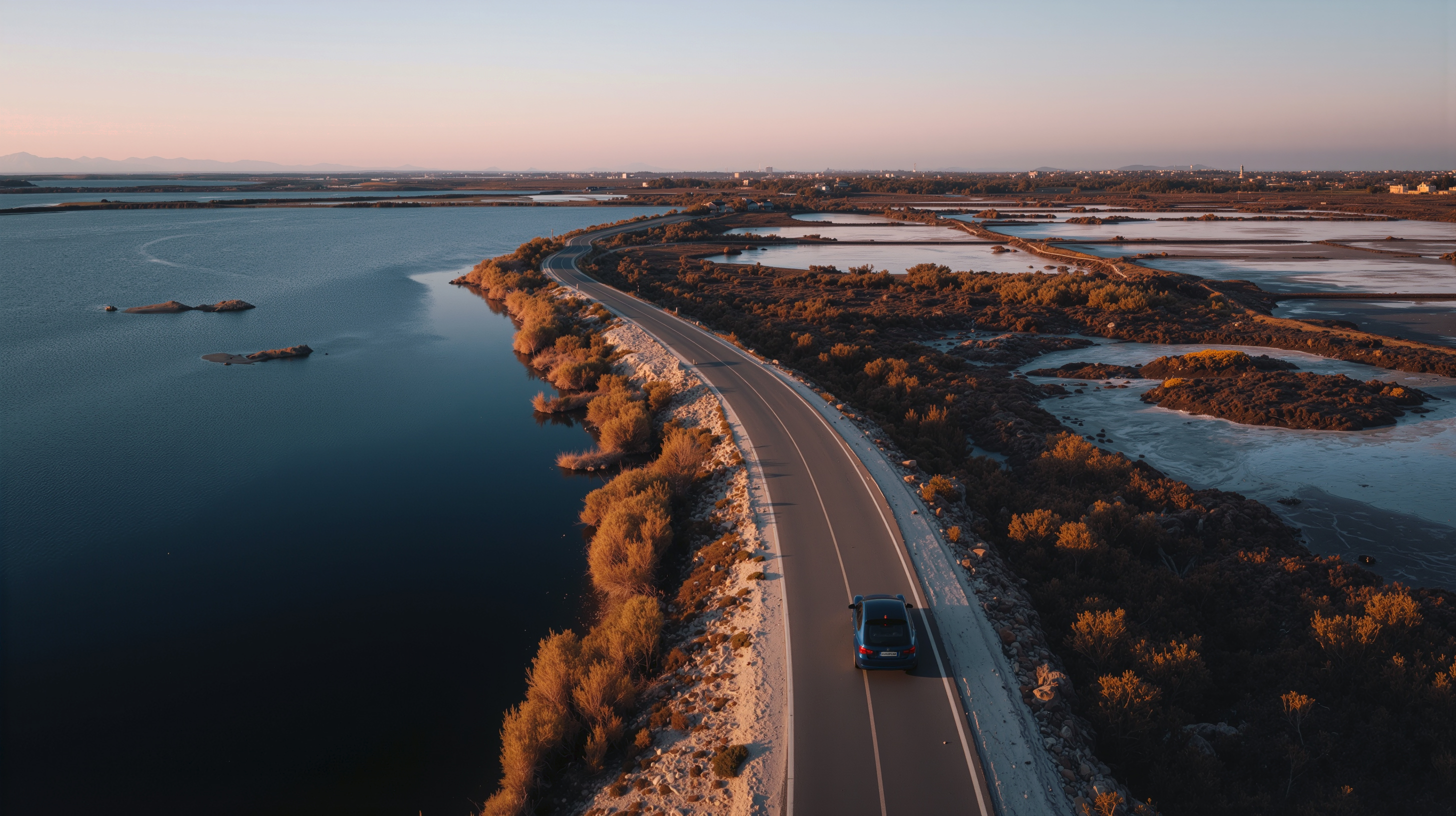
The Camargue goes far beyond the postcard version. You think you know it through white horses and flamingos. The reality is something else entirely. Wedged between the two arms of the Rhone and the Mediterranean, this wild land shifts every ten kilometers. Salt marshes give way to ponds tinted pink by brine. Beaches take the full force of the wind. In the middle of nowhere, fortified villages seem to stand watch over the horizon.
The Camargue invites an immediate disconnection. Distances are short — roughly a hundred kilometers separate Aigues-Mortes from Salin-de-Giraud — but the roads are slow, stops are frequent, and the urge to stay longer than planned comes naturally. Whether you’re heading out for a weekend from Montpellier or Marseille, or working the Camargue into a longer drive along the Mediterranean coast, here’s what you need to know to organize your trip by car.
Planning your Camargue road trip: what you need to know
The Camargue covers around 86,300 hectares in the Rhone delta, spanning the Bouches-du-Rhone and Gard departments. The regional nature park is not a fenced reserve with an entrance fee: access to the territory is free and open. The main roads are paved and easily manageable in a standard car. A standard rental car is more than enough to cover the key stops. There’s no need to rent a 4×4, unless you want to reach the Beauduc track, which requires a vehicle no wider than 2.10 meters.
The best season for this road trip is spring, April through June, or fall, September through November. In spring, temperatures are mild, flamingos are nesting in full force, and Camargue foals are out in the meadows. In October, the samphire turns the salt flats red, the light is golden, and the roads are nearly empty. Summer is best avoided for nature walks: punishing heat, relentless mosquitoes, and maximum crowds on the beaches and in the villages. Whatever month you come, pack a windbreaker: the Mistral blows across the Camargue roughly two days out of three.
For the length of the trip, plan for at least three days to cover the essentials. Five days gives you room to wander, cycle, and discover the less-visited spots like the Digue à la Mer or the Domaine de la Palissade.
| Good to know |
| Motorized vehicles are prohibited outside open roads across the entire park. No ATVs, no vehicles on the beaches. Wild camping has been strictly banned throughout the territory since 2016, including on the beaches of Piémanson and Beauduc, which were once more tolerant. Fines are enforced. Plan for an approved campsite or paid accommodation. |
Key stops on the road trip
Saintes-Maries-de-la-Mer, the heart of the Camargue
Saintes-Maries-de-la-Mer is the natural starting point for any Camargue road trip. This white village on the Mediterranean has something unexpected about it: a 12th-century fortified church that looks more like a castle than a place of worship, alleyways scented with lavender and spices, and a sandy beach a short walk from the center. Arrive, park at the Launes parking lot (free, five minutes on foot) and explore on foot.
The Notre-Dame-de-la-Mer church is the centerpiece. Entry to the interior is free. The crypt houses the statue of Saint Sara, the Black Virgin and patron of the Roma people, draped in colorful robes and surrounded by ex-votos. Access to the wall walk (53 spiral steps, 360° panorama over the marshes and sea) costs around $3 to $5 per person. A 45-minute visit that’s well worth it.
The great Roma pilgrimage takes place every year on May 24 and 25, drawing more than 10,000 people from across Europe. If your road trip falls around this date, plan ahead: parking becomes very difficult and accommodations fill up weeks in advance.
The beaches at Saintes-Maries are supervised in summer, walkable from the center, and far less crowded than those on the neighboring Languedoc coast. A day is enough to visit the village, but many travelers choose to stay the night to catch the sunset over the Mediterranean, one of the most beautiful in the region.
The regional nature park and the marshes
Four kilometers from Saintes-Maries along the D570, the Pont de Gau Ornithological Park is the most accessible and most reliable place to see flamingos up close. Its 60 hectares and 7 kilometers of marked trails host over 200 bird species. Admission is around $9 for adults and $5.50 for children aged 4 to 12. The park opens at 9 AM and trails remain accessible until sunset, a real advantage for golden-hour photography. The ticket is valid all day with re-entry permitted. Strollers and wheelchairs are welcome; animals, even on a leash, are strictly prohibited.
The regional nature park itself is open land, with no gates or entry fees. Several themed visitor centers offer paid visits and observation points over the ponds: La Capelière on the Vaccarès lagoon, the Domaine de la Palissade on the coastal side, the Marais du Vigueirat on the eastern delta. These sites are run by different organizations and offer reduced rates for children and groups. Check opening hours before leaving, as some close outside the tourist season.
This is where the Camargue reveals its true nature: birds rising by the hundreds at the slightest sound, white horses grazing freely along the roadside, black bulls in the meadows. Slow down. This territory doesn’t give itself to those who pass through in a hurry.
L’Espiguette beach and the wild coastline
L’Espiguette is one of the most beautiful and wildest beaches on the French Mediterranean coast. Ten kilometers of fine sand bordered by dunes up to twelve meters high, not a building in sight, and turquoise water that consistently surprises first-time visitors. Labeled Grand Site de France and classified as a Natura 2000 site, it’s well worth the detour from Aigues-Mortes or Saintes-Maries.
The drive from Le Grau-du-Roi takes about ten minutes along the Route de l’Espiguette. Two parking lots serve the area. The north lot, known as the Plage parking, is free and provides access to the supervised swimming area (early June to early September only). The Baronnets parking is paid in season: around $7.50 for the day from April 1 to September 30, reduced to $4.50 after 4:30 PM, and $16 for campervans. From this lot, a wooden boardwalk crosses the dunes for about 800 meters before reaching the sea. A pleasant walk, but worth keeping in mind with young children or people with limited mobility.
A few rules before you go: the beach is entirely smoke-free, dogs are prohibited from June 15 to September 15, and camping is strictly banned. A marked naturist zone exists at the southern end. The Espiguette Lighthouse, listed as a Historic Monument since 1987, can be visited by reservation.
To reach L’Espiguette by bike from Aigues-Mortes, a greenway follows the canal for 6 kilometers to Le Grau-du-Roi, then continues for another 5 kilometers to the beach. An ideal half-day itinerary, best combined with a morning visit to the ramparts.
Aigues-Mortes, the fortified city
Aigues-Mortes appears out of nowhere in the middle of the ponds. A perfectly preserved medieval city, ringed by intact ramparts, set in a completely flat landscape as far as the eye can see. The first view from the road is striking: square towers rising out of pink salt flats, a sight that never quite loses its impact.
The ramparts are managed by the Centre des Monuments Nationaux. Admission is around $13 in high season (May to August) and $10 from September to April. Entry is free for those under 18 regardless of nationality, for EU residents aged 18 to 25, for people with disabilities and their companion, and for job seekers. The first Sundays of January, February, March, November, and December are free for everyone. The full circuit (Tour de Constance then 1,634 meters of wall walk connecting twenty towers) takes between 90 minutes and two hours. The Tour de Constance, a 30-meter keep where Marie Durand carved the word “RÉSISTER” after 38 years of captivity, is one of the highlights.
The medieval center below can be explored freely and at no cost. Place Saint-Louis, the Notre-Dame-des-Sablons church, cobblestone alleyways, and shops selling pink salt: allow a good half-day to see everything without rushing. For parking, the P8 lot on the outskirts is the only one that’s free year-round, but spaces are limited. Lots near the ramparts are paid in season, between $7.50 and $11 per day.
Just outside the city, the Salins d’Aigues-Mortes can be visited by small train, a 75-minute narrated tour around the evaporation basins where flamingos feed. Admission is around $15 per adult and $11 per child. Walking and cycling options are also available. Online booking is recommended in summer. This is where Camargue pink salt truly makes sense: kilometers of crystals turning pink through the effect of micro-algae, a sight that catches even seasoned travelers off guard.
Camargue road trip by van or car: which should you choose?
It’s a question many people ask before leaving, and the answer mostly depends on how long you’re staying and how you like to travel.
For a weekend or three days, a standard rental car is the simplest and most economical choice. The main Camargue roads are all paved: the D570 between Arles and Saintes-Maries, the D36 toward Salin-de-Giraud, the D979 between Aigues-Mortes and Le Grau-du-Roi. None require a special vehicle. A compact car handles everything without issue. Europcar offers car rentals departing from Montpellier, Nîmes, Marseille, and Arles, with unlimited mileage on most packages. Worth confirming at booking, since distances add up quickly on a route that zigzags between the two sides of the delta.
A van is appealing for longer stays, a week or more. It lets you sleep on-site, skip the constraints of booking accommodation, and stop exactly where and when you want. In the Camargue, that’s a real advantage: morning light over the ponds or dusk on the salt flats sometimes means an early start, and having your bed right there changes everything. That said, wild camping is banned across the entire park territory. You’ll need a registered campsite or a dedicated service area. Several campsites welcome vans and motorhomes, including Yelloh! Village La Petite Camargue in Aigues-Mortes and Les Bois Flottés de Camargue between Piémanson and Beauduc.
One practical note with a van: the Beauduc track is only accessible to vehicles under 2.08 meters wide. Most fitted vans exceed this limit and won’t be able to get through. If Beauduc beach is on your itinerary, check your vehicle’s dimensions before booking.
An SUV isn’t necessary for this road trip. The only mildly demanding track is Beauduc, manageable in a standard car in dry conditions with care. The rest of the territory is entirely on paved roads. If your trip extends beyond the Camargue, toward the Alpilles or the Crau, an SUV offers a bit more comfort but remains optional.
Cycling in the Camargue: routes not to miss
Cycling is probably the best way to explore the Camargue. The terrain is flat, distances are manageable, and some routes are simply unreachable by car. You stop when you want, you hear the birds, you get close to the horses without startling them. It’s a different way to experience this territory.
The cycling network in the Camargue is constantly expanding, but it’s worth distinguishing dedicated greenways from roads shared with cars. The ViaRhôna (EuroVelo 17) is the reference route: it crosses the Camargue on a 52-kilometer paved greenway between Arles and Port-Saint-Louis-du-Rhône, following the Grand Rhône. An itinerary accessible to all levels, including families with children.
The Aigues-Mortes to Le Grau-du-Roi greenway follows the canal for 6 kilometers before continuing another 5 kilometers to L’Espiguette beach. Eleven car-free kilometers between salt flats and pine forests, ending with your feet in the water. One of the most enjoyable cycling rides in the region, and suitable for all types of travelers.
The Digue à la Mer is the wildest and most spectacular route. This 20-kilometer round trip between Saintes-Maries-de-la-Mer and the Gacholle lighthouse is closed to motorized vehicles but open to bikes and walkers. Ponds on one side, the sea on the other, and a narrow dike where flamingos pass within a few meters. Allow 3 to 4 hours for the full round trip, depending on your pace and how many photo stops you make. The Mistral can make the ride tough: check the weather before heading out.
Between Arles and Saintes-Maries, there’s no dedicated bike lane on the D570: the 37 kilometers run partly on a road shared with cars. A more scenic alternative goes through Albaron and the D37 along the Vaccarès, less traffic and more pleasant by bike.
For rentals, several providers operate in the main towns: Le Vélo Saintois in Saintes-Maries-de-la-Mer, Taco and Co in Arles, and bike-share stations in Aigues-Mortes. Mountain bikes are recommended for the Digue à la Mer and dirt tracks, city bikes work fine on paved greenways. Half-day rentals are often available, making it easy to combine cycling in the morning and driving in the afternoon.
What budget should you plan for your Camargue road trip?
A Camargue road trip doesn’t have to be expensive, but a few cost lines are worth anticipating to avoid surprises.
Car rental is the first item to budget for. Departing from Montpellier, Nîmes, or Marseille, expect to pay between $45 and $90 per day for a standard car, depending on the season and rental length. High season (July and August) pushes prices up noticeably. Booking in advance through Europcar generally gets you better rates, especially on unlimited mileage, which is essential on an itinerary that criss-crosses between both sides of the delta.
Paid admissions add up quickly if you’re not paying attention. Factor in the Aigues-Mortes ramparts ($10 to $13 depending on season), the Pont de Gau Ornithological Park ($9), the salt flats by small train ($15), and the Espiguette parking ($7.50), and a full day can top $50 per person before lunch. One way to keep costs down: concentrate the paid visits over two days and spend the rest of the time on free activities (Digue à la Mer, Gacholle lighthouse, the Aigues-Mortes medieval center, the beaches).
For accommodation, camping is the most fitting option for the spirit of the place. Several quality campsites are spread along the route: Yelloh! Village La Petite Camargue in Aigues-Mortes for families, Les Bois Flottés de Camargue for nature lovers, Le Clos du Rhône in Saintes-Maries for those who want the sea close at hand. Expect between $27 and $50 per night for a tent or van pitch in high season, less outside July and August. The territory’s farmhouses and guesthouses offer a more authentic immersion in Camargue life, often at rates comparable to a standard hotel.
For meals, the villages all have restaurants built around local specialties: gardiane de taureau (slow-cooked bull stew), tellines (local clams), Camargue rice, and fougasse with orange blossom in Aigues-Mortes. The Monday and Friday morning markets in Saintes-Maries are a great option for putting together a picnic and meeting local producers.
One last practical tip: download offline maps before you leave. Mobile coverage is spotty in the most remote parts of the park, especially along the Digue à la Mer and around Beauduc. The Camargue Regional Nature Park app lists marked trails, water points, and observation sites. And pack sunscreen, a hat, and mosquito repellent from spring onward: the areas around the ponds are generous on that front.
Key takeaways
- Plan for at least 3 days, ideally 5, for a complete road trip between Aigues-Mortes, Saintes-Maries-de-la-Mer, and Salin-de-Giraud
- A standard rental car covers all the main roads — an SUV is only useful for the Beauduc track (vehicle width under 2.08 m required)
- Wild camping is banned across the entire park territory, including on Piémanson and Beauduc beaches — book an approved campsite
- Best season: April to June or September to November, for the light, the flamingos, and far fewer mosquitoes
- Paid admissions to plan for: Aigues-Mortes ramparts ($10 to $13), Pont de Gau Ornithological Park ($9), salt flats by small train ($15), Espiguette parking ($7.50)
- The Digue à la Mer (20 km round trip) is closed to motorized vehicles: bikes and walkers only — one of the most beautiful routes in the territory
- The Saintes-Maries Roma pilgrimage is on May 24 and 25: accommodations fill up and parking is difficult during this period
- Bring a windbreaker, mosquito repellent from spring onward, and download offline maps — coverage is unreliable in the most remote areas of the park