Road trip Scotland: Highlands, Loch Ness and Isle of Skye
Summary
- 1. Which car to rent and how to drive in Scotland?
- 2. Edinburgh as your starting point
- 3. The road into the Highlands: Glencoe and Fort William
- 4. Loch Ness and Inverness
- 5. The Isle of Skye, the highlight of the road trip
- 6. Practical tips for planning your Scotland road trip
- 7. Key takeaways for your Scotland road trip
Road trip in Scotland: a one-week itinerary through the Highlands and the Isle of Skye
Scotland occupies the northern third of Great Britain. The country divides into three main regions: the Lowlands in the south, home to Edinburgh and Glasgow; the Highlands in the north, with their wild moorlands, lochs, and peaks; and the islands, nearly 790 in total, including the Inner Hebrides where the Isle of Skye sits. Scotland is reachable by plane in around two hours from most major US East Coast cities via connecting flights, and its proximity to major European hubs makes it one of the more accessible UK destinations.
Traveling Scotland by car is the only way to see it properly. The train connects Edinburgh to Inverness well enough, but it doesn’t reach Glencoe, doesn’t skirt the shores of Loch Ness, and doesn’t get you to the Isle of Skye. The most striking landscapes in Scotland are found between the stops, on roads that wind through the hills, follow the lochs, and cut through valleys without a house in sight. A week behind the wheel is the right format for a first trip.
Here is our itinerary from Edinburgh, with the key stops, driving tips, and practical information to plan your Scotland road trip without any bad surprises.
Which car to rent and how to drive in Scotland?
A compact car handles the main routes between Edinburgh, Inverness, and Fort William without issue. But as soon as you turn off toward the Highland back roads or the Isle of Skye, vehicle size matters.
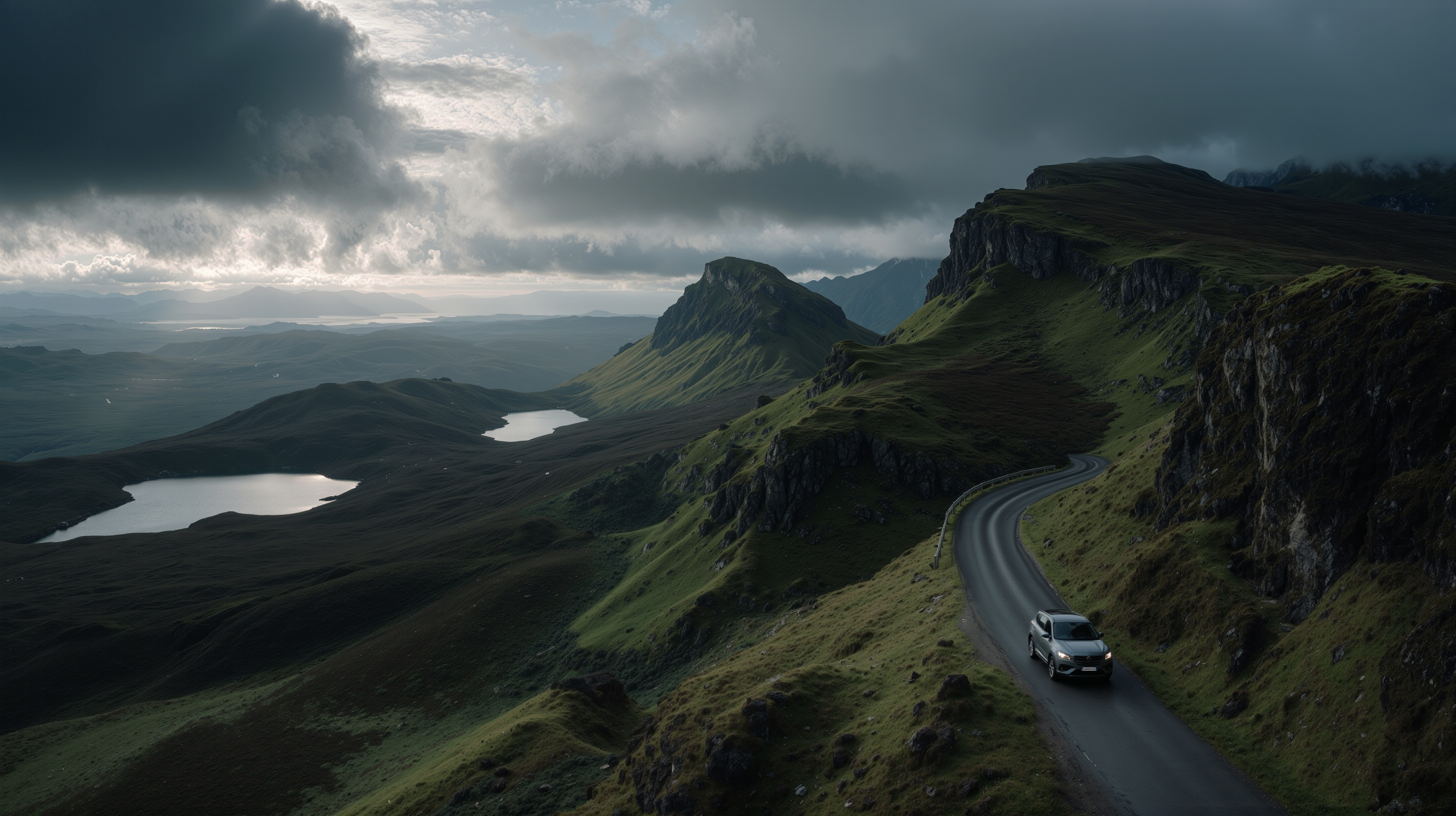
Single-track roads are common across the north of the country: narrow, often without lane markings, edged with stone walls or drainage ditches. A small, maneuverable vehicle is clearly better suited than a large SUV.
Europcar offers rentals departing from Edinburgh, with a wide range of categories to suit group size and budget. Booking before departure is strongly recommended, particularly in high season: fleets run dry quickly in July and August.
The first rule of driving in Scotland is one everyone knows but few truly anticipate: you drive on the left. The first few miles take real concentration, especially at intersections and roundabouts, where the natural instinct pushes you toward the wrong lane.
The second rule, specific to the Highlands, is the passing place system. On single-track roads, marked lay-bys allow vehicles to pass or overtake. The rule is simple: if a car comes toward you, whoever is closest to a passing place pulls in and waits. If a vehicle behind you wants to overtake, you pull in and let it through. Ignoring this rule is not just dangerous, it’s considered extremely poor form locally.
One last practical point: gas stations thin out quickly once you leave the towns. In the northern Highlands and on the Isle of Skye, filling up whenever the tank drops below half is a habit worth building from day one.
| Good to know |
| Passing places don’t just help oncoming traffic get through: they’re also where you pull over to let faster vehicles behind you pass. If a car closes in on your rearview mirror on a single-track road, the local convention is to stop at the next lay-by and wave it through. It’s an unwritten rule, but one that’s universally observed across the Highlands. |
Edinburgh as your starting point
The Scottish capital is the natural gateway for this road trip. Edinburgh Airport is well-connected, with direct or one-stop flights from most major US cities. Start here: renting a car in Edinburgh makes far more sense than hunting for a rental in Inverness or Glasgow if the itinerary starts here.
Plan for one to two nights in the city. Not to tick off a checklist, but because Edinburgh rewards being walked slowly, getting lost in its alleyways. Edinburgh Castle, perched on its volcanic rock, is the essential visit: the view from the ramparts over the city and the surrounding hills gives you a first taste of what the country has to offer in terms of scenery. The Royal Mile runs downhill from the castle to the Palace of Holyroodhouse, flanked by closes, those narrow medieval passageways that cut away on either side of the main street. The Grassmarket neighborhood below is the liveliest spot in the evening: old pubs, local beers, and the atmosphere of a city that knows how to welcome visitors.
Pick up the car on the morning you leave for the Highlands, not the night before. Taking the vehicle on departure day avoids paying for a rental night you’ll spend with the car sitting unused in a parking garage, and Edinburgh’s streets are not the ideal place to get used to left-hand driving.
The road into the Highlands: Glencoe and Fort William
Heading northwest from Edinburgh, the landscape shifts gradually. The capital’s outskirts give way to the rolling Lowland hills, then to the first stretches of open moorland. Allow around two and a half hours to reach Glencoe, the real entry point into the Highlands.
Glencoe Valley is one of the most photographed landscapes in Scotland, and for good reason. Steep mountains drop directly onto the road, the hillsides are streaked with waterfalls, and the light changes constantly with the weather. In overcast conditions, the valley takes on a dark, dramatic tone that suits it well. In clear weather, it’s simply spectacular. Several hiking trails leave directly from the road: the Lochan Trails are accessible at all fitness levels and deliver open views over the entire valley in under an hour.
From Glencoe, the road continues to Fort William, about thirty minutes away. It’s the largest town in this part of the Highlands: you fill up the tank, find a bed, grab a meal. More importantly, it opens the road to one of the most anticipated stops of the trip, twenty minutes northwest: the Glenfinnan Viaduct.
Built in 1898, the viaduct spans the valley for 380 meters across 21 arches. It’s known worldwide for serving as the backdrop for the Hogwarts Express in Harry Potter and the Chamber of Secrets. A viewpoint near the visitor center lets you take in the full structure from above. To see the Jacobite Steam Train cross the arches, check the schedule in advance: it runs between Fort William and Mallaig from May to October, and seats book up weeks ahead in peak season.
The Glenfinnan Monument, on the shores of Loch Shiel just opposite the visitor center, is worth a stop too. The loch stretching behind the monument appears in the Harry Potter films as the Hogwarts lake. Fan or not, the setting is remarkable.
Plan for a night in or around Fort William. The road north toward Loch Ness picks up from here the following morning.
Loch Ness and Inverness
From Fort William, allow around an hour and a half northeast to reach the shores of Loch Ness. The loch stretches 37 kilometers, narrow and almost opaque black from the peat suspended in the water. The monster, for its part, remains elusive.
Driving around the loch takes two hours without stops, but stops come naturally. Urquhart Castle, on the western shore, is the essential visit: its ruins rise directly from the loch’s edge with a panorama that justifies the detour on its own. Book tickets online before you leave, the site draws large crowds in high season and lines can be long. A cruise on the loch departing from Fort Augustus is also a solid option for those who want to see the landscape from the water.
Inverness, capital of the Highlands, sits at the northern end of the loch. It’s a comfortable, well-equipped city and the right place for a night before heading to the Isle of Skye the next day. The city center follows the River Ness, with its painted houses and a handful of pubs worth an evening stop.
The Isle of Skye, the highlight of the road trip
The Isle of Skye lies about two hours southwest of Inverness by road. Before arriving, a stop at Eilean Donan Castle is non-negotiable: it sits fifteen minutes from the bridge that connects the island to the Scottish mainland, perched on a small islet at the confluence of three lochs, linked to the shore by a stone bridge. It’s one of the most photographed castles in Scotland, and the setting earns it.
The Kyle of Lochalsh bridge is free and gives direct car access to the island. No ferry needed for this stretch of the itinerary. Once on the Isle of Skye, Portree is the main town: a few hundred residents, a harbor lined with painted houses, restaurants, and the most accessible accommodation on the island.
Two sites stand above the rest. The Fairy Pools first, in the southwest: a series of turquoise rock pools at the foot of the Cuillin mountains, reached after a thirty-minute walk from the parking area. The Old Man of Storr next, in the northeast: a rock formation rising 719 meters above the sea, with a round-trip hike of around two hours. The Quiraing, a little further north on the same peninsula, offers even wilder scenery and noticeably fewer visitors.
Plan for at least two nights on the island. One day is not enough, and accommodation on Skye books up weeks in advance in high season. Options outside Portree, in the small hamlets of the Trotternish peninsula, tend to be quieter and often come with sweeping morning views.
Practical tips for planning your Scotland road trip
Season
The best window for this road trip runs from May through September. In May and June, the days are long, the landscape is green, and accommodation is still available at reasonable rates. July and August are the busiest months: the Isle of Skye and Loch Ness pull significant crowds, roads around the most popular sites back up, and prices climb. September is an excellent alternative: the light is beautiful, the crowds thin, and the landscapes start taking on their autumn colors.
Accommodation
This is the most critical part of the planning. Across the Highlands and on the Isle of Skye, supply is limited and demand is high in peak season. Properties can fill up weeks or even months ahead. Booking as soon as the itinerary is set isn’t just a precaution, it’s a necessity. Guesthouses and B&Bs are the most characterful option and often the most enjoyable: full Scottish breakfast included, direct contact with locals, settings that are frequently remarkable. Expect to pay between $90 and $145 per night for two people depending on location and season.
Budget
Between the car rental, fuel, accommodation, and meals, a one-week Scotland road trip for two people runs around $1,650 to $2,200 all-in, excluding flights. The British pound remains strong against the dollar, which shows up in daily costs. Pubs consistently offer the best value for meals: hearty food, local atmosphere, and prices that compare favorably to sit-down restaurants.
The North Coast 500
If the trip stretches to ten days or more, the NC 500 is the natural extension of this itinerary. This 500-mile route loops around the northern Highlands from Inverness, past cliffs, wild beaches, and remote villages. It’s widely regarded as one of the most scenic drives in Europe. An extra week is enough to cover the essentials without rushing.
Key takeaways for your Scotland road trip
- Edinburgh is the ideal starting point: well-connected airport, pick up the car on the morning you head for the Highlands
- Drive on the left and use the passing places: two rules to absorb from the very first mile
- Fill up whenever you can in the northern Highlands and on the Isle of Skye, gas stations disappear fast
- Glencoe is the perfect entry into the Highlands: leave time for at least one hike
- The Glenfinnan Viaduct viewpoint is free, but seeing the Jacobite Steam Train cross it requires booking tickets well in advance
- Urquhart Castle on Loch Ness: book online before you leave, do not improvise in high season
- The Isle of Skye deserves at least two nights: accommodation books up weeks ahead in July and August
- Budget for two people over a week runs around $1,650 to $2,200 all-in, excluding flights
- The North Coast 500 is the natural follow-on for anyone with ten days or more