Road trip Tuscany: the cities and villages not to miss
Summary
- 1. Which car to rent for a Tuscany road trip?
- 2. Pisa and Lucca: the right start for your road trip
- 3. Florence, the heart of Tuscany
- 4. San Gimignano and Volterra, the villages that stay with you
- 5. Siena, the piazza and the cathedral
- 6. Val d’Orcia and Pienza, the Tuscany of postcards
- 7. Key takeaways for this Tuscany road trip
Road trip in Tuscany: a one-week itinerary between cities and villages
Tuscany is a region in central Italy, wedged between the Tyrrhenian Sea to the west and the Apennines to the east. Florence is its capital. But there are other UNESCO-listed cities whose historic centers have come through the centuries almost intact: Siena, Pisa, Lucca, Arezzo. Between them, the countryside: hills planted with vines and cypress trees, fortified villages perched on ridges, and roads that wind without ever running straight.
Traveling Tuscany by car makes real sense. The train connects the main cities well enough, but it doesn’t reach the Val d’Orcia, doesn’t pass through San Gimignano or Volterra. To see the region in its entirety, you need a car. A week is the right format: enough for the major stops, enough to slow down when a village is worth lingering in.
Here is an itinerary built from Pisa down to the south of the region, with the key stops and a few practical tips to organize the trip.
Which car to rent for a Tuscany road trip?
A compact car handles the majority of this road trip just fine. The main roads between Pisa, Florence, and Siena are wide and well-maintained. But as soon as you head toward the villages, things change. The roads through the Chianti, those leading to Volterra or Pienza, are often narrow, sometimes without lane markings, with tight bends and crossings that call for a bit of patience. A small footprint is a genuine advantage.
If you’re traveling as four with luggage, a compact SUV stays comfortable without being unwieldy. Parking areas around the villages are often simple gravel lots, sometimes tight: a compact vehicle maneuvers far more easily than a large SUV.
For the rental, the simplest option is to pick up the vehicle directly at Pisa airport, the natural starting point for this itinerary. Europcar offers rentals departing from Pisa as well as Florence, with a wide range of categories depending on group size and budget.
| Good to know |
| The historic centers of Florence, Siena, Pisa, and Lucca are ZTL zones (limited traffic areas). Entering by car without authorization exposes you to a fine of around $110 per violation, recorded automatically by camera. Park at the lots marked at the entrance to each town and continue on foot. If you’re staying at a hotel inside a ZTL zone, the property can register your plate and regularize the situation. |
Pisa and Lucca: the right start for your road trip
Pisa is the ideal first stop for this road trip. The airport is 3 km from the city center, flights from the US often connect through major European hubs, and prices are frequently more competitive than Florence. Pick up the car at the rental counter, and the adventure can begin.
The city is worth half a day. The Piazza dei Miracoli has it all: the Leaning Tower, built in the 12th century, the Duomo, and the Baptistery form a monumental ensemble that holds your attention. The city center of Pisa is also worth exploring: the banks of the Arno, the alleyways, a terrace for a first Italian spritz.
The next day, head to Lucca, 30 minutes east. It’s a medieval city with some of the best-preserved ramparts in Italy. You can walk the full circuit on foot: 4 km of promenade with open views over the rooftops and surrounding countryside. The Piazza dell’Anfiteatro, at the heart of the city, has kept the oval shape of the Roman amphitheater on which it was built. The ideal spot for lunch before hitting the road toward Florence.
Florence, the heart of Tuscany
Florence is the city that justifies the trip to Tuscany on its own. The regional capital concentrates a density of masterpieces unmatched anywhere in Italy. Two days is the minimum to take in the essentials without rushing.
The Duomo announces itself from the moment you arrive. The Santa Maria del Fiore cathedral and Brunelleschi’s dome dominate the city from every angle. You see it appear between alleyways before you’ve even figured out where you are. Entry to the cathedral is free; the climb to the dome is paid but well worth it for the view over the rooftops and the surrounding hills.
A short walk away, the Uffizi Gallery holds the largest collection of Renaissance paintings in the world. Plan for a minimum of two to three hours, and book tickets online before you leave home to avoid lines that can be very long regardless of the season.
Florence is a permanently busy city. The best approach is to start early, when the center’s alleyways are still quiet. Past 10 AM, the Piazza del Duomo and the area around the Uffizi are packed. In the evening, the city finds a more breathable rhythm. That’s the right moment to cross the Ponte Vecchio and head up toward the Oltrarno neighborhood, on the left bank of the Arno.
San Gimignano and Volterra, the villages that stay with you
Leaving Florence to the south, the scenery shifts entirely. Highways give way to country roads that cut through Chianti vineyards, pass isolated farmhouses, and climb toward villages perched on their hilltops.
San Gimignano announces itself from a distance through its medieval towers rising above the roofline. Fourteen remain out of the 72 the city had at its peak: built by noble families as symbols of wealth and power, the taller the tower, the more powerful the family. The village is UNESCO-listed and explored on foot, following cobblestone alleyways to the Piazza della Cisterna and the Piazza del Duomo. It’s our favorite among all the villages in the region. Renting a car to visit San Gimignano is the only practical way to get there.
Thirty minutes away, Volterra is quieter but just as striking. The city sits on a ridge at 550 meters, ringed by Etruscan and medieval ramparts. Far fewer crowds than San Gimignano, authentic alleyways, and the Guarnacci Etruscan museum for anyone interested in the history of the region.
Siena, the piazza and the cathedral
Siena is 50 minutes south of San Gimignano. The city is worth an overnight stay. A day covers the visits, but staying the night lets you see it differently, in the evening once the tour buses have left and the city settles back into its own pace.
The historic center is UNESCO-listed. Everything revolves around the Piazza del Campo, a shell-shaped square gently tilted toward its center, lined with cafes and restaurants. This is where the Palio takes place, the famous horse race that brings the city’s different neighborhoods together twice a year, in July and August. Outside that period, the square is still a place apart. You sit, you have lunch, you watch people go by.
Siena’s cathedral is one of the finest examples of Gothic architecture in Italy. The black-and-white marble facade, the mosaic floor inside, and the baptistery below are impressive and can be visited at a reasonable price. From the Basilica of San Domenico, a few minutes on foot, you get an open view over the cathedral and the city’s rooftops.
Plan to park at the lots at the entrance to the city and continue on foot. Siena’s center is a ZTL zone and the alleyways are too narrow to navigate comfortably by car anyway.
Val d’Orcia and Pienza, the Tuscany of postcards
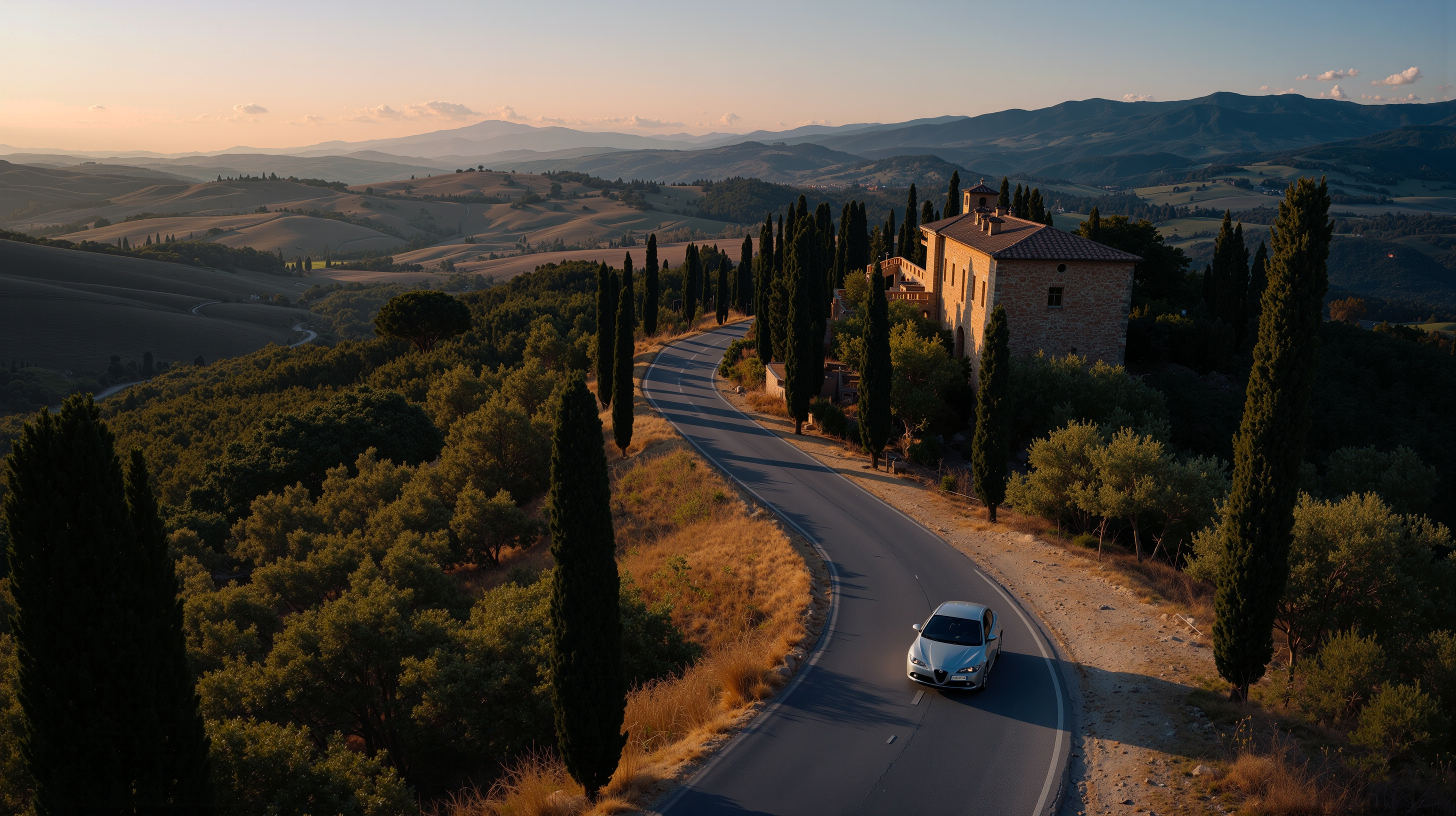
The Val d’Orcia is an hour’s drive south of Siena. This UNESCO World Heritage valley is probably the most photographed landscape in the entire region. Known for its gentle hills planted with cypress trees, isolated farmhouses on ridges, and fields that change color with the seasons. The drive itself is a pleasure.
Pienza is the unmissable village of this part of the trip. Built in the 15th century as the ideal Renaissance city on the orders of Pope Pius II, it has kept its original layout almost intact. The center is small (easily explored in an hour) but every street and every square is worth looking up at. The view from the ramparts over the valley below is one of the finest in Tuscany.
Nearby, Montalcino is worth a stop for its wine, the Brunello, and for its village perched at 500 meters. Montepulciano, a little further east, offers the same kind of sweeping view over the Tuscan countryside.
For those who want to end the trip gently, the Saturnia hot springs are 45 minutes southwest. Natural hot water cascades into travertine pools. Access to the outdoor falls is free, and the site is open year-round.
Key takeaways for this Tuscany road trip
- Pisa is the best starting point: flights are often cheaper than into Florence and the car is waiting right at the airport
- A compact car handles the main roads fine, but a small footprint helps on the narrow Chianti and village roads
- Watch the ZTL zones: in all the major cities, the car stays at the parking lot and you continue on foot
- Seven days is the right pace: enough to cover everything, enough to stop when a village earns it
- Book the Uffizi in Florence online, well in advance
- The Val d’Orcia is even more beautiful early in the morning, before the tour buses arrive: plan a night in Pienza or nearby
- Saturnia at the end of the trip: free natural hot springs, open year-round — a perfect way to decompress before heading home