Road trip Sardinia: turquoise beaches and nuragic culture
Summary
- 1. Road trip in Sardinia: a practical itinerary between beaches and villages
- 2. When to go and how long to plan for a Sardinia road trip?
- 3. Where to start: Olbia, the Costa Smeralda, and the La Maddalena archipelago
- 4. Alghero, the Gulf of Orosei, and the nuraghi: the heart of the island
- 5. Cagliari and the south: a capital that surprises
- 6. Van or car, camping or hotel: what’s the best choice for this road trip?
- 7. Key takeaways
Road trip in Sardinia: a practical itinerary between beaches and villages
We planned to stay a week. We stayed ten days. That’s what often happens in Sardinia when you travel by car: you take a road to see a beach, and you stumble on a village you weren’t looking for.
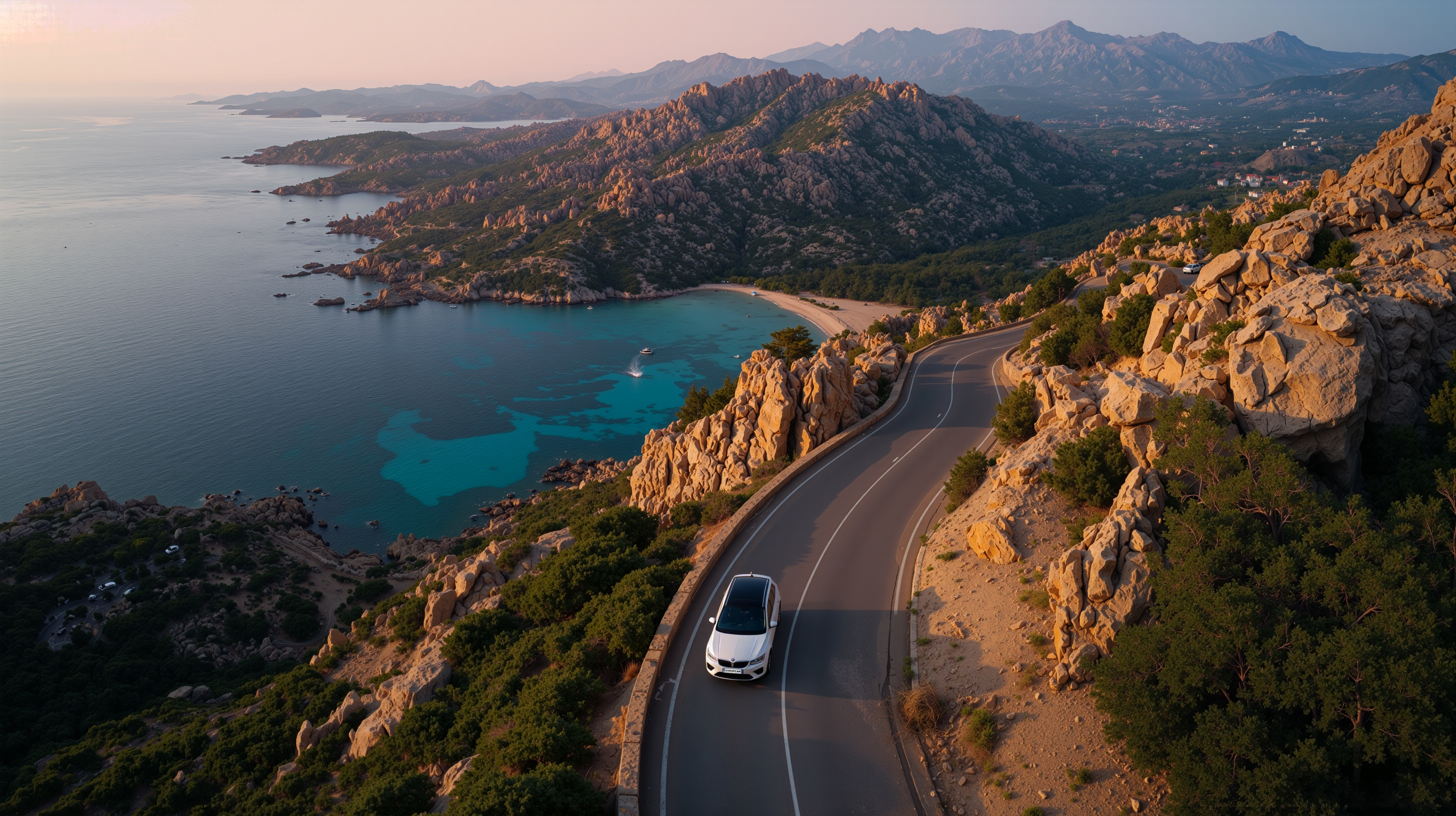
The island is large (over 24,000 square kilometers) and its density of landscapes surprises even those who think they know it. In an hour and a half by car, you move from the granite coves of the Costa Smeralda to the cliffs of the Supramonte, then to the dunes of the Costa Verde. Sardinia is an island of multiple itineraries, where each day holds something unexpected.
Best season, trip length, vehicle type, access to regulated beaches, nuragic site prices: here are the key stops and practical tips to organize this road trip without any bad surprises.
When to go and how long to plan for a Sardinia road trip?
The season question is central to this trip. Summer remains the most popular time to enjoy the beaches, but it’s also the most crowded and the most expensive. For a more authentic experience, spring or fall is the better call: May to June or September to October. You’ll get mild weather, lush landscapes, and sites that aren’t overrun.
If you want to avoid the crowds and high prices, July and August are best skipped. That’s when mainland Italians descend on the island for their summer holidays. Outside the summer season, many hotels and restaurants in the northern beach resorts close down: check opening times before finalizing your itinerary.
For the length of the trip, a week is enough to cover the classics: Costa Smeralda, Gulf of Orosei, Barbagia, and Cagliari. Ten days opens up the wild west coast, the Piscinas dunes, and the Sulcis islands. Two weeks lets you do everything without rushing, with detours into the interior and deeper dives into nuragic culture.
Three airports make arrival straightforward: Olbia Costa Smeralda in the northeast, Cagliari Elmas in the south, and Alghero Fertilia in the west. For a north-south or south-north route, one-way rentals are possible. Rental companies offer one-way options with a surcharge of $55 to $200 depending on the distance. Europcar is present at all three airports: you can rent a car in Olbia, in Cagliari, or in Alghero depending on your starting point.
| Good to know |
| Sardinia has no road tolls. The SS 125, stretching 354 kilometers, is entirely manageable in a standard car, but it winds through the Supramonte in tight switchbacks that require concentration. In towns, watch for ZTL zones (limited traffic areas) marked by signs and cameras: a violation can result in a fine forwarded by the rental company several weeks after you get home. Fuel costs around $2 per liter. Fill up whenever you can in remote areas, gas stations get sparse quickly. |
Where to start: Olbia, the Costa Smeralda, and the La Maddalena archipelago
Is the Costa Smeralda really worth it?
Short answer: yes. Long answer: it depends on what you’re looking for.
Olbia is the natural entry point for the north of the island. The city itself is pleasant without being spectacular: an old center with a few small squares, cobblestone alleyways, the feel of an Italian port town. Half a day there before heading southeast toward the Costa Smeralda.
The coast is famous for its turquoise water and wealthy clientele. Porto Cervo and its yachts, Porto Rotondo and its villas, the beaches of Capriccioli and Liscia Ruja among the most photographed in the Mediterranean. But the Costa Smeralda gets very busy in July and August, and prices follow: accommodation, restaurants, and boat rentals reach levels that are hard to justify outside peak season. If you only have one day on the Costa Smeralda, spend it on the beach and head to Porto Cervo in the early evening, when the resort starts coming alive. Out of season, the magic works differently: the coves are nearly empty, the roads clear, and the color of the water remains unchanged.
How to get to the La Maddalena archipelago?
About twenty kilometers north of the Costa Smeralda, Palau is the departure point for the La Maddalena archipelago. Several Delcomar or Maddalena Lines ferries make the crossing in around twenty minutes, year-round. You can take your car on board, which is practical for exploring the archipelago at your own pace without depending on shuttle services.
The main island, La Maddalena, is connected by a free causeway to the island of Caprera, where Giuseppe Garibaldi spent the last years of his life. His home is now a museum that history enthusiasts will appreciate. But nature takes center stage here: the first national park created in Sardinia protects these milky waters and granite islets. The archipelago’s beaches rank among the most beautiful on the island: shallow water, exceptional clarity, limited crowds outside peak season. In summer, some coves like Cala Coticcio on Caprera are only accessible on foot and, in high season, with a certified environmental guide to protect the site.
The car ferry for two passengers round trip between Palau and La Maddalena costs around $44. Book ahead in July and August, as evening crossings frequently sell out.
Castelsardo, the hilltop village of the northwest
Heading west from Palau, Castelsardo appears after about an hour and a half of coastal driving. The medieval village sits on a rocky headland that drops directly into the sea, a silhouette you recognize instantly from the road that hugs the northern coastline. Weather can be unpredictable on this stretch in the shoulder seasons, but the panorama of the hilltop village as you approach from the east is one of the most striking on the island.
The historic center is explored on foot, through narrow alleyways that climb toward the medieval castle overlooking the bay. Local craftspeople here carry on a tradition of basket weaving in dwarf palm leaves, a craft specific to this region. One to two hours is enough for the visit, before heading south toward Alghero, about an hour away.
Alghero, the Gulf of Orosei, and the nuraghi: the heart of the island
Alghero and La Pelosa beach: how to organize your visit?
Alghero is one of the most pleasant cities in Sardinia to base yourself for a few days. Its historic center still bears the mark of several centuries of Catalan rule. The streets are narrow and cobblestoned, the ramparts look directly out to sea, and the local dialect still carries traces of Aragonese. An hour walking the old town is enough to understand why this city appears in almost every Sardinia road trip itinerary.
About 50 kilometers northwest of Alghero, La Pelosa beach is one of the island’s most famous and also one of its most regulated. Access is capped at 1,400 people per day, split into two options: 700 tickets bookable at any time between June 1 and October 31, and 700 tickets released only 48 hours before the chosen date. The ticket price is around $3.80 per person, free for children under 12. Booking is done through the official La Pelosa app. You can access the beach freely without a reservation after 6 PM.
The beach is just 2 kilometers from the village of Stintino, with paid roadside parking. In high season, arrive early or book several weeks ahead: morning slots go within hours. Beach towels placed directly on the sand are prohibited to limit dune erosion: swimmers must place a mat under their towel.
About ten kilometers from Alghero, the Spiaggia di Lazzaretto offers a quieter alternative: white sand, shallow water ideal for snorkeling, and far fewer people than La Pelosa. A good stop for a late afternoon before heading toward the Gulf of Orosei.
The Gulf of Orosei: which beaches and how to get there?
The Gulf of Orosei is the wildest and most spectacular stretch of the Sardinian coastline. Limestone cliffs drop directly into deep blue water, and the most beautiful coves are unreachable by road or on foot from the shore, making boat the only option. That inaccessibility is exactly what preserves them and gives them their singular character.
Cala Gonone is the departure village for boat excursions into the gulf’s coves. From the small harbor, shared shuttles or private boats head to Cala Luna, Cala Sisine, or Cala Mariolu depending on the schedule. Cala Goloritzè, accessible only on foot from the plateau, limits entry to 250 people per day at a cost of $6.50 including parking and trail access. Reservations are made through the Heart of Sardinia app.
The road that follows the gulf, the SS 125, is one of the most beautiful on the island. It climbs to the Genna Silana pass at 1,017 meters, one of the highest road points in Sardinia, with a 360-degree panorama over the limestone ridges. Allow more time than the map suggests: the bends are tight, the viewpoints numerous, and the urge to stop frequent.
What exactly are the nuraghi?
It’s hard to drive across Sardinia without encountering these grey stone towers rising from the landscape. The nuraghi are circular defensive structures shaped like truncated cones, built from cut stone with corbelled vaulted interior chambers, unique to Sardinia. The earliest date to the Middle and Late Bronze Age, between 1600 and 1200 BC. More than 7,000 have been counted across the island, some standing alone in the middle of fields, others grouped into village complexes.
The unmissable site is Su Nuraxi in Barumini, in the south-central part of the island. It is the only Sardinian site inscribed on UNESCO’s World Heritage List, and the most imposing among the thirty nuragic sites in the surrounding area. Visits are guided only, last about an hour, and guides are available in English. Full price is $13, reduced to $10 for ages 13 to 17 and groups of 20 or more, and $7.50 for children aged 7 to 12. The site is about 60 kilometers south of Cagliari. The ticket also includes a visit to the Casa Zapata, a museum housed in a 16th-century Aragonese manor house, beneath which a second nuraghe was discovered during restoration work.
Cagliari and the south: a capital that surprises
Cagliari is often reduced to a logistical stop: arrival city, airport, car return. That’s a mistake. The Sardinian capital deserves at least a full day, and ideally two.
The old town, the Castello quarter, rises up a hill that dominates the port and the coastal plain. Medieval ramparts, cobblestone alleyways, the Santa Maria cathedral with its baroque façades, and the two Aragonese towers (Torre dell’Elefante and Torre di San Pancrazio) open onto panoramas that look out over the sea on one side and the lagoons on the other. The National Archaeological Museum of Cagliari brings together the remains of nuragic civilization and makes a natural complement to a visit to Su Nuraxi. If you didn’t make the detour to Barumini, this is where nuragic culture really falls into place.
The San Benedetto market, one of the largest covered markets in Italy, is a must for anyone interested in local food. Pecorino cheeses, bottarga, culurgiones pasta, vermentino wines: everything the island produces is here, in the atmosphere of a working-class market far from the tourist boutiques of the center.
For beaches, the Poetto beach stretches for several kilometers east of the city. This long expanse of fine sand is lined with bars and restaurants and remains accessible by bus from central Cagliari. Handy if you’ve already returned your rental car.
To the southeast, the road toward Villasimius follows a spectacular coastline with views over salt lagoons that regularly host flamingo colonies. Punta Molentis, one of the most beautiful beaches in the area, requires a mandatory reservation in high season through the Pass Villasimius system. Prices range from $1.10 to $3.80 per person depending on the site, with daily caps of 500 to 1,500 visitors on the most popular beaches.
To the west of Cagliari, the Costa del Sud offers a less crowded and equally beautiful alternative. The wild coastal area shelters some of Sardinia’s finest beaches, including Chia and Su Giudeu beach, with crystal-clear water and impressive dunes. This area is also home to the archaeological site of Nora, an ancient Phoenician and Roman city partially submerged, a visit that naturally extends the nuragic itinerary started earlier in the trip.
Van or car, camping or hotel: what’s the best choice for this road trip?
It’s the question that comes up on every Sardinia forum, and the honest answer is: it depends on how long you have, what you’re looking for, and which month you’re going.
A rental car remains the most flexible and straightforward choice for most travelers. The rental market in Sardinia is spread across around thirty operators (major international brands, Italian networks, and local agencies). The best availability is at the three airports, where counters stay open until midnight in high season. Expect between $33 and $77 per day depending on the season and insurance options. A week in May runs around $275, while August can exceed $660. Booking several weeks ahead in summer isn’t just a precaution: fleets run dry quickly on an island where everyone rents at the same time.
For hotels, options are plentiful in the main cities like Cagliari, Olbia, and Alghero, as well as in the Costa Smeralda beach resorts. Outside those areas, farmhouses and agriturismos offer an immersion in Sardinian life that standard hotels don’t provide: farm meals, local produce, direct contact with locals. In high season, book well ahead: San Teodoro, for example, has fewer than 5,000 year-round residents but welcomed nearly 120,000 tourists in August 2022. Accommodation fills up there by June.
A fitted van appeals for two-week stays or longer. It offers more flexibility and cuts costs by skipping hotel nights. Sardinia lends itself well to this style of travel: campervan sites are plentiful, roads are uncongested off-season, and the itinerant culture is well accepted. That said, wild camping on beaches is banned across almost all of the Sardinian coastline, particularly in protected areas. Fines are real and enforced. Plan for approved campsites or official motorhome areas, and check local regulations before settling in.
One last point that’s often overlooked: insurance. Sardinian roads can be winding and steep. Comprehensive coverage is recommended. Also check what your credit card covers before taking the rental company’s insurance package, and photograph the vehicle thoroughly before driving off. Several travelers have reported unexpected charges for alleged scratches on return.
Key takeaways
- Best season for a Sardinia road trip is May to June or September to October: mild weather, less crowded beaches, and lower prices than peak summer
- Plan at least a week for the classics (Costa Smeralda, Gulf of Orosei, Cagliari), ten days to add the west coast and southern islands, two weeks to do everything without rushing
- Three entry airports depending on your route: Olbia in the northeast, Alghero in the west, Cagliari in the south — one-way rentals are possible with a $55 to $200 surcharge
- The SS 125 between Olbia and Cagliari (354 km) is manageable in a standard car, no tolls — but ZTL zones in towns can generate fines forwarded by the rental company after your return
- La Pelosa beach is regulated: access capped at 1,400 people per day, ticket at $3.80, mandatory reservation from June 1 to October 31 through the official app
- Cala Goloritzè in the Gulf of Orosei is accessible on foot only, capped at 250 people per day at $6.50 per person — book through the Heart of Sardinia app
- Su Nuraxi in Barumini, the only UNESCO-listed Sardinian site, is guided visits only (available in English) at $13 full price, 60 km from Cagliari
- The Palau–La Maddalena ferry costs around $44 round trip for a car and two passengers — several crossings daily, year-round
- Fuel costs around $2 per liter: fill up in major towns, gas stations are scarce in remote areas
- Photograph the vehicle thoroughly before driving off — several travelers have reported unexpected charges for scratches on return